Sheet R02 Revision 1 Counted 16 October 2026
Online bingo: the one room with no duty to print what it pays back
A book of 360 tickets at 5p is £18.00 of stake. What comes back depends on a figure the room need never publish, so the honest answer is a band: £12.60 if the room returns 70 pence in the pound, £16.20 if it returns 90. That gap of £3.60 is why a bingo credit cannot be priced the way a reel credit can.
The count 360 tickets One ticket 5p Comes to £12.60 to £16.20
What a count of this size comes to
Every destination on this board is bought advertising. The site takes a fee if a reader goes on to register, and no figure printed below moves because of it.
The Spin Count
Gauge No 01
Betportal
Lowest multiple here
Priced at this site's own 10p a spin
What is counted
What is asked
No Great Britain licence
Licensed in Anjouan, Comoros, run by BetPortal Gaming Ltd, with Excite Ultra Media Ltd, reference ALSI-202601040-FI2.
Terms read 16 October 2026
Open the offer at Betportal, opens in a new tabThe Spin Count
Gauge No 02
WinBeast
Largest count here
Priced at this site's own 10p a spin
What is counted
What is asked
No Great Britain licence
Licensed in Curaçao, operator not named on the site.
Terms read 16 October 2026
Open the offer at WinBeast, opens in a new tabThe Spin Count
Gauge No 03
EliteSpin
Longest spin window
Priced at this site's own 10p a spin
What is counted
What is asked
No Great Britain licence
Licensed in Costa Rica, run by PrimeTier Limited.
Terms read 16 October 2026
Open the offer at EliteSpin, opens in a new tabThe Spin Count
Gauge No 04
Crown Jewelz
Multiple unpublished
No foot figure struck
What is counted
What is asked
No Great Britain licence
Licensed in Curaçao, number not verified, operator not named on the site.
Terms read 16 October 2026
Open the offer at Crown Jewelz, opens in a new tabThe figure in the third register is this site's own arithmetic and nothing an operator has published: the count at face, less the share a spin gives back at 96 per cent return to player, less what playing the wagering through costs at the same return. It describes the offer, not one reader's afternoon. Where the conditions price above the count the counter prints nothing rather than a negative sum, and where a figure the sum needs is unpublished it prints the condition in the operator's words instead.
A count has no unit of its own, so one is supplied. Where an operator publishes what a spin of its own is worth, that figure stands in the second register and is labelled as theirs. Where it does not, the second register carries this site's own 10p a spin and says so, and the foot figure moves in proportion: at half the price, half the money. The figure after it, what the count comes to for each spin, is the one that compares a large count against a small one.
Three words stand in the amount column where no figure can. Noted is a published condition that takes value away without leaving the sum a figure to take. Unpriced is a condition whose figure nobody has published, or a credit that is not a sum until a deposit of your own sets it. Own money is money of yours, which is never part of a foot figure.
Not one of the operators printed above holds a Great Britain licence, so the duties that licence carries do not reach them. Every online gambling company licensed in Great Britain has to be part of Gamstop Online, and a reader who has shut themselves out through the scheme is therefore not shut out here. The ceiling of ten times the bonus funds on a wagering requirement, in force since 19 January 2026, is a condition of that licence and binds the companies that hold one. Where a dispute goes instead is a matter for the authority named on the counter, and the Gambling Commission describes what a reader faces without a British licence as a lack of recourse if things go wrong. Nobody under 18 may hold an account at any of them.
Every term printed on a counter is the operator's own, and each counter carries the day it was read. The oldest of those readings is 16 October 2026. What binds a reader is the operator's own full terms, and not a line printed here.
1
A book of tickets is a count too
This site exists to turn a headline tally into money, and a bingo headline is a tally like any other. Free tickets, bonus tickets, a hundred cards on a Tuesday night: each is a count of chances with the price of one left out. Put the price in and the face value appears at once. Three hundred and sixty tickets at 5p apiece is £18.00 of stake laid out on the reader’s behalf.
From that point the bingo room parts company with the reel room, and it parts company over an input rather than an opinion. On a reel the arithmetic runs count times price times return, three numbers, one multiplication. In a bingo room the third number may never be published, and no rule compels it.
So the honest output here is a range rather than a figure. Hand £18.00 of ticket stake to a room returning 70 pence in the pound and £12.60 comes back on average. At 75 pence it is £13.50. At 80 pence, £14.40. At 85 pence, £15.30. At 90 pence, £16.20. Those five lines are the page in miniature, and nothing in a headline tells a reader which of them applies.
The range is not a hedge. It is the result. A reader comparing a ticket book against a tray of reel presses is comparing one instrument whose return is reachable with another whose return may not be, and the comparison cannot be closed by assumption. Where this site’s own 96 per cent figure is used below, it is used to show what a reel would have done with the same stake, and it is labelled every time.
No Great Britain licence sits behind those cashiers, and a book of 360 is handed out most freely by them. 70 pence to 90 was the band above; out there it widens rather than narrowing. Part nine runs the duties that fall away one at a time, each priced against this book of 360, because a list of absent protections means little until somebody puts pence against the items.
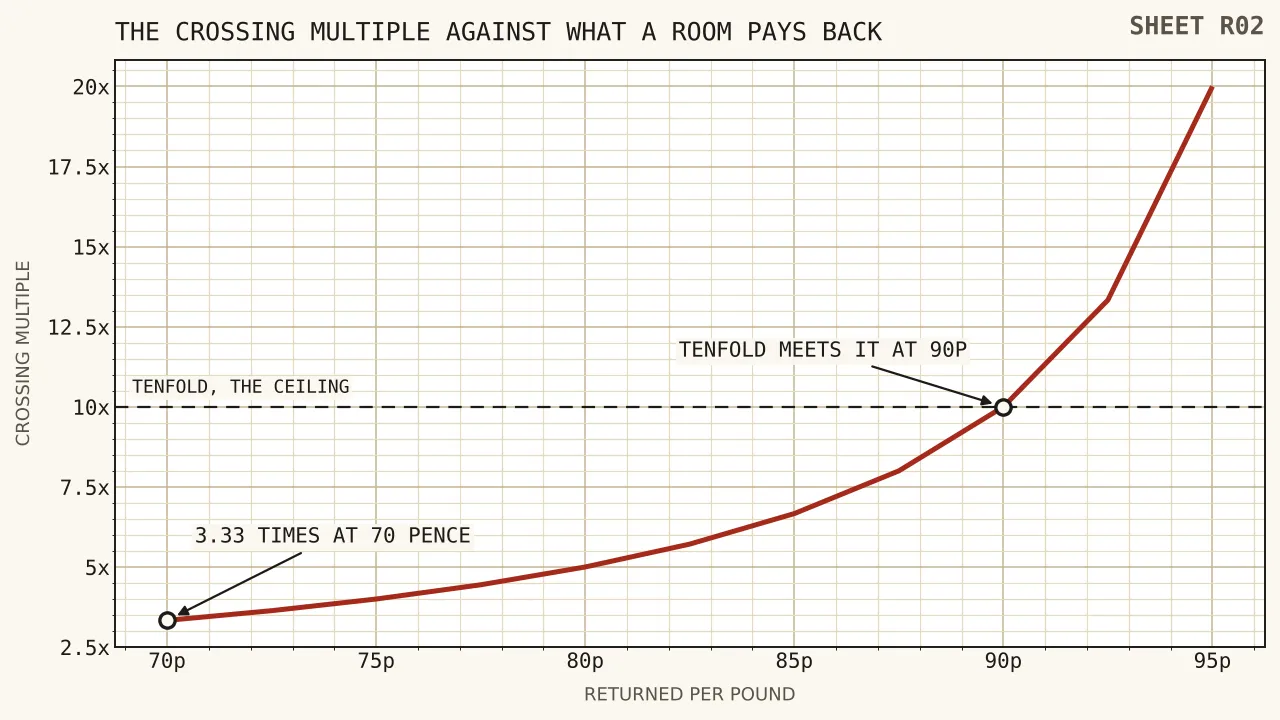
Notation for the page. B is the stake handed over, here £18.00. R is what the room pays back per pound, unknown in this room and therefore run as a band from 70 pence to 90. W is the turnover multiple in the terms. The crossing multiple, the point where a credit is expected to reach nothing, is one divided by one minus R, and in a bingo room it moves further than most readers would believe.
2
The missing input, and why it is missing
A licensed room owes a customer something about their prospects, reachable before the commitment is made, and that duty is real enough. What makes the bingo case peculiar is the way the duty may be discharged. Four items satisfy it, joined by an “or”, and the guidance under the standard goes further for this room specifically: where bingo is in question, and in some lottery and other games too, setting out the way the prizes get allocated is enough on its own.
Read that carefully and a reader’s position becomes clear. A description of how a prize pool is divided among the winners is a complete answer to the duty. A description of that kind contains no percentage, so nothing in it divides into £18.00. The reader can be fully informed, in the sense the standard means, and still have no number to multiply.
Two things do follow from the standard and are worth keeping. The rules themselves must be reachable and must be accurate and sufficient to explain all of them. Reachable before the commitment as well: the potential prizes, the potential payouts, or else whatever method determines or calculates them. A pool structure disclosed in that way is the input a reader actually gets.
Which is why this page will not guess. No primary source reachable for this site publishes a bingo return, a distribution of bingo returns, or a floor under one. Nothing on this page may therefore say what a bingo room pays back, and the band from 70 to 90 pence is a demonstration device, stated as one, not a report of the market.
The comparison that can be made is structural, and it is sharper than a guess would have been. On a reel the percentage sits among the permitted disclosures and is often present. In this room a prize description is sufficient by the guidance’s own words, so the percentage is the least likely of the four to appear. The asymmetry is in the rulebook rather than in the operator’s intentions.
£18.00 of ticket stake, and a return between 70 and 90 pence a pound that nobody is obliged to state
3
Pricing the band instead of the number
A band is still arithmetic. It yields a worst case, a best case and a width, and the width is itself a figure a reader can act on. Across the band used here the width on 360 tickets is £3.60, which is 20 per cent of the face value and exactly 72 tickets’ worth.
Compare that with the reel room on the same money. Where a reel returns 96 pence a pound, £18.00 of stake averages £17.28. The top of the bingo band, at 90 pence, averages £16.20. So the best case in this room sits £1.08 under what a reel would have returned, and the worst case sits £4.68 under it. Those two gaps are the cost of the room, before any condition is applied.
| Room pays back | Average return | Behind a 96p reel by | Crossing multiple | Left at tenfold |
|---|---|---|---|---|
| 70 pence | £12.60 | £4.68 | 3.33x | short by £25.20 |
| 75 pence | £13.50 | £3.78 | 4.00x | short by £20.25 |
| 80 pence | £14.40 | £2.88 | 5.00x | short by £14.40 |
| 85 pence | £15.30 | £1.98 | 6.67x | short by £7.65 |
| 90 pence | £16.20 | £1.08 | 10.00x | nothing |
| 95 pence | £17.10 | £0.18 | 20.00x | £8.55 |
The fourth column is where the page turns. It gives the multiple at which a credit in that room is expected to arrive at nothing, and it is one divided by the room’s own edge. Thirty pence of edge gives 3.33. Twenty-five pence gives 4. Twenty gives 5. Fifteen gives 6.67. Ten gives 10. Five gives 20.
A withdrawal floor reads off the same band, and it reads as a second condition. Where the terms set the smallest payable sum at £10.00, every row of the band clears it on the average, the thinnest by £2.60 and the fattest by £6.20. Raise the floor to £15.00 and the position inverts: the 70, 75 and 80 pence rows all finish under it on the mean, short by £2.40, £1.50 and £0.60, so a reader sitting in one of those rooms is paid nothing at all unless the average is beaten. Expressed as a multiple of the mean, a £15.00 floor asks 1.19 times at 70 pence, 1.11 at 75, 1.04 at 80, and nothing extra from 85 upwards. None of that is published either, since the floor sits in the cashier’s terms and the return sits nowhere.
Two floors and a band give a reader three numbers to hold at once, so here they are in one line. Face £18.00. Mean somewhere between £12.60 and £16.20. Smallest payable sum unknown until the terms are open. A count advertised without the second and third of those is a count advertised without its unit.
Set the regulated ceiling of ten times beside that column and the result is uncomfortable. Bonus funds may not be asked to turn over more than ten times by a British licensee, and 90 pence a pound is the return whose crossing lands on exactly that figure. Every row above it in the table crosses sooner. So in this room the lawful maximum requirement is at or past the point of exhaustion unless the return is at the very top of the band, and the reader has no published way to tell.
4
Where the crossing multiple lands
Two mechanisms are moving at once here and they need separating. The first is the return, handled above. The second is the contribution rate: how much of a staked pound counts towards a requirement in the room where the staking must happen.
Taken together they give the condition this whole section runs on. A credit keeps something only while the contribution rate beats the multiple divided by the crossing figure for that room. At a 96 per cent reel the crossing figure is 25, so the rate must beat W over 25. In a bingo room returning 80 pence the crossing figure is 5, so the rate must beat W over 5, which is five times as demanding.
Worked on this book of tickets, with the staking served in the same room at full contribution: a tenfold requirement on £14.40 of credit is £144.00 of turnover, which is 2,880 tickets at 5p. Each pound of that turnover meets a twenty pence edge, so the expected cost is £28.80. The credit was £14.40. The requirement costs twice what it is clearing.
Drop the contribution rate and the figure runs away. At half contribution the same requirement needs £288.00 of turnover and 5,760 tickets. At a quarter it needs £576.00 and 11,520 tickets. A ticket book that looked like an evening becomes a month of evenings, and the arithmetic is doing all of it silently.
| Staked pound counts as | Turnover owed | Tickets at 5p | Cost at a 20p edge | Largest clearable multiple |
|---|---|---|---|---|
| 100 pence | £144.00 | 2,880 | £28.80 | 5.00x |
| 75 pence | £192.00 | 3,840 | £38.40 | 3.75x |
| 50 pence | £288.00 | 5,760 | £57.60 | 2.50x |
| 25 pence | £576.00 | 11,520 | £115.20 | 1.25x |
| 10 pence | £1,440.00 | 28,800 | £288.00 | 0.50x |
Read the last column downwards. In a room returning 80 pence a pound, a contribution rate of ten pence cannot carry a requirement of even half a times. There is no offer anywhere with a multiple that low, so every row below the top is a credit the arithmetic expects to finish at nothing or worse.
5
A prize pool divides, a reel pays
Why should a bingo room’s return sit lower and move more than a reel’s? Because the two instruments are built differently, and the difference is structural rather than commercial.
A reel settles each cycle against a fixed paytable. Its expected return belongs to the machine, reads the same whether one player is present or ten thousand, and takes no notice of who else turned up. A bingo game settles a pool. Ticket money goes in, a share comes out as prizes, and the share that reaches any one player depends on how many tickets were sold, how the pool is split between the lines and the full house, and what the house keeps.
Three consequences follow for a count of free tickets. First: whatever the return is, it belongs to the game as configured on the night rather than to the ticket. Second, a bigger room is not automatically a better room: a large pool divided among more holders can leave a given ticket with the same expectation and a far longer wait. Third, the arithmetic of a count cannot be done ticket by ticket in the way it can be done press by press, since the tickets in one game are not independent of each other.
That last point has a practical edge. A tray of 360 reel presses is 360 separate experiments, and the average behaves itself. A book of 360 bingo tickets spread over, say, 24 games of 15 tickets is 24 experiments in which 15 tickets compete partly with each other. The expectation is unchanged. The spread around it is not, and a reader meeting a withdrawal floor needs the spread as much as the average.
Put arithmetic on the pool to see the shape of it. Suppose 400 tickets sold into one game at 5p, which is £20.00 of ticket money, and suppose the house keeps a fifth. £16.00 then leaves as prizes, which is a return of 80 pence in the pound, and a single ticket’s share of the expectation is 4p against the 5p it cost. Keep every figure and double the room: 800 tickets at 5p is £40.00 in, £32.00 out, and a ticket is still worth 4p. The pool grew by £16.00 and the ticket gained nothing, because the prize and the competition for it grew together. That is the whole reason a headline about a big jackpot room is not a statement about what a ticket is worth.
Now hold the house share and move it instead. At a tenth kept, the return is 90 pence and the ticket is worth 4.5p. At a quarter kept, 75 pence and 3.75p. At a third, about 66.7 pence and 3.33p. Three house shares, three ticket values, one unchanged headline, and the share is the figure nobody has to print. Those three numbers are this site’s own illustration of a pool split and not a report of any room’s terms.
None of the above is a sourced claim about any room’s figures. It is the arithmetic of a pooled prize against a fixed paytable, and it is set out here so that the band in part three is understood as a consequence of the structure rather than as this page being coy.
6
Tickets and spins cannot share a condition
One rule in this market bites harder on bingo than on anything else, and it has a date: 19 January 2026. From that day a single incentive offered by a British licensee has been confined to one type of gambling product. The rule lists four types. Bingo is one of them in its own right, and casino is another.
Reels sit inside casino. Tickets sit inside bingo. A package built from cash and reel presses therefore stays inside a single type and may be cleared through one shared requirement. A package built from cash and a ticket book reaches across two types and may not. That is a reading of the rule’s own four-item list, offered as such.
For a reader the consequence is arithmetical and it is good news. Where an incentive cannot link the two, the ticket book’s requirement must stand on the ticket book’s own terms, and the condition in part four has to be met in the room where the credit sits rather than exported to a reel. A requirement that can be cleared on reels at full contribution and 96 pence a pound carries 25. The same requirement confined to a room returning 80 pence carries 5. Separating the products stops the better room from being used to launder the worse one, and it also stops the worse room from borrowing the better one’s arithmetic.
Three exceptions run against the grain of the rule, and all three come from the regulator. One: two products of the same type may share an incentive, a scratchcard beside a raffle being the illustration offered. Two: where marketing consent has been given for each product separately, one email may present a betting offer and a casino offer together. Three: a credit the customer may aim at any product they like, ten pounds spendable across casino and betting being the illustration, is untouched.
That third exception is the one worth noticing on a bingo page, because it describes the only version of a cross-product offer that survives. Direction is worth money: a credit the reader aims themselves need never enter a room counting five pence, and on the figures here the two destinations carry 25 and 1.25 respectively.
7
Which rules reach this room and which miss it
Several of the sharpest product rules in the British market are written against slots, and a reader who has read a slots page may carry them into the bingo room by mistake. Here is where each one actually lands.
Autoplay is the rule that does reach this room, and it reaches it by name. Its stated aim: to make clear that auto-play cannot be offered for online gaming. Its requirement: individual commitment to each game cycle. Its scope: gaming, with bingo written in. A single carve-out, and bingo cannot use it: automatic blinds at a poker table where players face each other. So a book of 360 cannot be set running and walked away from.
The random-outcome standard reaches bingo too. Its scope covers gaming including bingo, lotteries and betting on virtual events. Inside the same standard sits the near-miss prohibition. Out go features and designs liable, on a reasonable expectation, to mislead over the likelihood of some particular result. Two instances are named. One substitutes a near-miss loss for the loss that belonged there. The other simulates a real device while running probabilities the device does not have.
The cash ceiling on a single stake does not reach this room. Reel-based, played online, a casino game: that is the instrument’s own definition of what the ceiling attaches to, and the regulator’s guidance keeps it from travelling to anything else. Nothing in it fixes a maximum ticket price.
The pace floors do not name bingo either. Slots carry the two and a half seconds. Casino games that are not slots carry five, peer-to-peer poker excepted. Bingo is picked out by neither phrase, so this page records where the two floors are written and stops there rather than inferring a third.
One identity provision carries a bingo-shaped exclusion worth knowing. Identity obtained and verified before gambling begins is a condition reaching remote licences generally, including the ancillary remote betting kind for bets taken by telephone or email. Its exclusions make a list of their own: ancillary remote bingo, ancillary remote casino, host, gambling software, gaming machine technical, and lotteries running nothing but low-frequency or subscription draws. Read it as scope rather than as a loophole: the remote bingo licence a web room runs on is not an ancillary one.
| Rule | Reaches a bingo room |
|---|---|
| Commitment per game cycle | Yes, scope given as gaming including bingo |
| Acceptably random outcomes | Yes, same scope |
| No near-miss substitution | Yes, same scope |
| Cash ceiling on one stake | No, written against reel-based casino games |
| Minimum gap between cycles | Written against slots and other casino games, not named for bingo |
| Return percentage published | Not required, a prize-allocation description suffices |
8
The adjudicator list has a bingo gap in it
Eight weeks is the outer bound on a British licensee’s complaints process, escalation inside the business included, and at the end of it the customer has to be pointed at an adjudicator. Approval by the regulator gates that choice, and eight bodies hold it. Their sector coverage is not uniform, and for a bingo player the unevenness is worth reading before it is needed rather than after.
Count them by coverage. Five carry remote work in every sector. Two more read as all sectors in the table, one of that pair carrying its own entry that names betting and nothing else. The last of the eight reads differently again: an adult gaming centre, bingo off the internet, a family entertainment centre, public houses and members clubs, with remote casino absent from its row. A removal note on the same list records a former provider dropping off it.
Price that against the book of tickets. The credit under dispute in the worst row of part three is £12.60. An eight-week clock and a free adjudicator are the only machinery that gets a sum of that size reviewed by anybody, because the cost of any other route exceeds the sum several times over. Four sentences from the regulator settle what it will not do for a sum of that size. Ombudsman is a description it rejects. Settling a gambling complaint, or recovering money, is outside the powers it holds. A withdrawal that will not run, or a game that has faulted, are both outside them too. Nor does it reach into customer accounts, which leaves it unable to see what went on inside one.
Two operator-side clocks are worth carrying with that. Three working days is the outer limit on acknowledging a complaint, as soon as reasonably possible being the standard, and 24 hours replaces the three days where the facilities never close. The window for bringing one runs at least six months from the incident, and terms may not bar a complaint inside it. Seven days of silence against a reasonable request for information may stop the eight weeks, which then resume from the point they halted at.
Eight weeks and an approved adjudicator, over a disputed £12.60
9
A ticket book with the rulebook taken away
Everything above describes a licensed room. Nothing out there holds a Great Britain licence, and the identical book of 360 gets advertised anyway. 5p a ticket is unchanged; what changes is the ledger below, walked in the order a reader meets it with pence set against each line.
Before the first ticket: identity. Three items go in before any gambling at all, verified and not merely collected: birth date, postal address, name. Bonus-funded play sits inside the duty, and so do the versions of the games that take no stake. Without that licence the whole £18.00 may be staked on an account nobody has checked. The register’s figure for the national self-exclusion scheme was 614,738 consumers, published 16 July 2026, and every one of those registrations relies on a licensed room checking who is in front of it.
At the cashier, credit cards are refused as payment for gambling under a British licence. Route one through a money service business and the same refusal catches it. Off the register no such refusal exists, so turnover of £144.00 at tenfold can be funded on borrowing. A financial limit is the default choice that has to be presented, declinable only by a positive act, with 24 hours, 7 days and 1 month among the periods on offer; a cut lands at once and a rise waits a day at the least. None of that machinery is owed to a reader off the register, and the sum it would have stood in front of here is £144.00.
While the game runs, four duties: a commitment per cycle; outcomes that are acceptably random; a loss that is never dressed as an almost; and silence where the return has not beaten what was staked. Each of those is a rule a bingo room with a British licence carries. None of them is a rule a room without one carries, and the arithmetic of the band in part three loses its only guarantee of honesty when the randomness requirement goes.
At the exit, two duties. A withdrawal once requested stands, with no cancel button offered against it. And a deposit balance may not be capped by any term, the regulator printing its own specimen of the barred wording, which pairs a daily fifty with a weekly five hundred. A maximum win attached to bonus winnings is a different balance and is not caught by that, which is why one document can carry both figures without contradicting itself.
And afterwards: the eight-week clock, the approved adjudicator, the regulator’s own published register of actions. A complaints route does exist on the Curaçao side, and saying otherwise would be false. The figures run 26 weeks, then 4, then 4, then 1: half a year in which a player may bring one, four weeks for the operator’s answer, one written extension of the same length, and seven days to confirm receipt. Adjudication is obligatory there, and the operator rather than the player pays for it. The parameters of it, though, get written by the operator. Two get named in the policy: the binding force of an outcome on the player, and any floor value a claim must clear before escalation is available. A disputed £12.60 is precisely the size that such a floor removes.
Two further figures close the ledger. Search the Curaçao responsible gaming policy, at version 1.0, for a ceiling over any wagering multiple and the count comes back nil. That document carries 21 February 2025, and the ten times holding a British requirement down has no counterpart anywhere inside it. Exclusion out there is arranged operator by operator. A year is the shortest term available, where the British scheme opens at six months, and that scheme’s own terms concede the limit: organisations staying outside it are beyond its help.
Questions
- What is a book of 360 bingo tickets at 5p actually worth?
- Face value is £18.00. What comes back is a band, because the room’s return need not be published: £12.60 at 70 pence in the pound, £14.40 at 80 pence, £16.20 at 90 pence. For comparison, the same stake on a reel returning 96 pence averages £17.28, so the room costs between £1.08 and £4.68 before any condition is applied.
- Why does a bingo room not have to publish a return figure?
- Four routes satisfy the duty to put a customer’s chances within reach, with an “or” between them, and for bingo the guidance treats prize allocation described in words as enough by itself. A pool description contains no percentage, so a reader can be properly informed and still have nothing that divides into £18.00.
- How do I find the multiple at which a bingo credit runs out?
- Divide one by the room’s edge. Thirty pence of edge gives 3.33 times. Twenty-five pence gives 4. Twenty pence gives 5. Fifteen pence gives 6.67. Ten pence gives 10. The regulated maximum requirement on bonus funds is ten times, so unless the room pays back 90 pence or better, that lawful maximum is already at or past the point where the credit is expected to reach nothing.
- Can a single offer pay me in tickets and in reel presses at once?
- Not where the terms are linked and shared inside one incentive, which is how it has stood from 19 January 2026. The rule’s own list runs to four product types, and a single incentive may hold just one of them. Bingo is a type in its own right and reels count as casino, so the two cannot be cleared through one shared requirement. Where the customer picks the product, the credit escapes that ban entirely.
- Do the five pound and two pound stake ceilings cap a bingo ticket?
- No. Both figures belong to online slots, an expression the instrument defines by three features, being a casino game, being reel-based and being played online, and the regulator’s guidance keeps them off every other game. Nothing published fixes a maximum price for a bingo ticket, so a ticket at 5p and a ticket at 50p are both inside the rules.
- Is autoplay allowed in a bingo room?
- It is not. Making clear that auto-play cannot be offered for online gaming is how the standard states its aim. What it demands of the system is a separate commitment to each cycle, all 24 of them in a 15-ticket evening. Gaming, with bingo written into the scope, is where it applies. The single carve-out concerns automatically posting blinds in peer-to-peer poker, which is not a bingo feature.
- How many tickets does a tenfold requirement actually take?
- On a credit of £14.40, tenfold is £144.00 of turnover, which is 2,880 tickets at 5p where the room counts a staked pound in full. At half contribution it is 5,760 tickets, at a quarter 11,520, and at ten pence in the pound 28,800. In a room with a twenty pence edge that first figure costs £28.80 to produce, which is twice the credit it is clearing.
- Which adjudicators cover a remote bingo dispute?
- Approval by the regulator is what makes an adjudicator usable at all, and the approved list runs to eight names. Coverage splits five, two and one. Five hold remote work in every sector. Two read as all sectors in the table, one of that pair carrying its own betting-only entry. The last covers an adult gaming centre, bingo off the internet, a family entertainment centre, and public houses and members clubs, with remote casino missing from its row. The list also records that one provider has been removed.
- Can the regulator recover a disputed £12.60 for me?
- No, and the regulator puts that beyond doubt itself, in four separate statements. What it says it is not is an ombudsman. Complaint resolution and the return of a consumer’s money are both absent from its powers. A stalled withdrawal and a faulted game are not cases it takes. Customer accounts are shut to it. Complain to the business first is the instruction it gives instead, and the eight weeks with an approved name at the end of them is the whole of the route.
- What changes when the bingo room has no British licence?
- The whole ledger in part nine, taken in the order a reader meets it. Everything in part nine, taken in the order a reader meets it. No Great Britain licence is held by the cashier handing those out, so £18.00 can go on the table before anybody has checked who put it there, a credit card can fund the £144.00 of turnover, no limit is set in front of the reader by default, the randomness and near-miss duties that give the band in part three any meaning are gone, and a deposit balance may be capped. A ceiling of ten times has no counterpart in the 21 February 2025 policy either. A complaints route does exist there, with six months to bring one and a free adjudication the operator pays for, but the operator writes its parameters, including any minimum claim value, and a disputed £12.60 is the size such a value excludes.